Pines and junipers are quite slow to recover from transplant but this year’s transplants from the Shibui Bonsai grow beds are now looking strong and healthy.
Black pines and Shimpaku now available
Reply
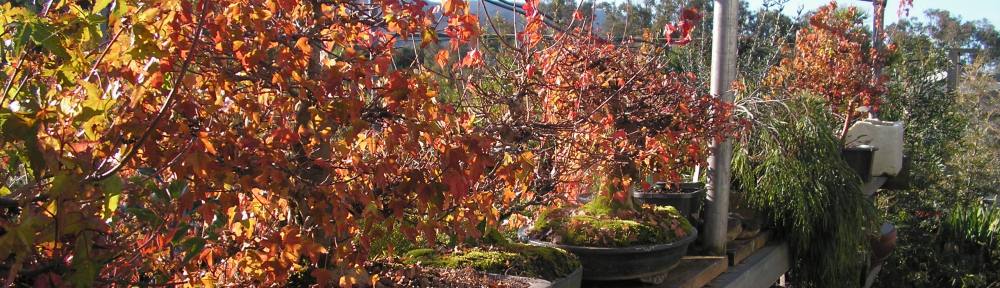
Pines and junipers are quite slow to recover from transplant but this year’s transplants from the Shibui Bonsai grow beds are now looking strong and healthy.
Today is the last day of 2017 which means it is well into summer at Shibui Bonsai and that means it is time for repotting some of the bonsai.
Last week I gave my Callistemon its annual after flowering prune. This one is Callistemon sieberii – River bottlebrush which flowers later than most Callistemon species, normally Early-mid December here. 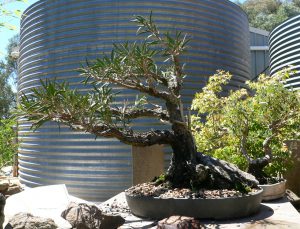
Some say it cannot be done…..
Here at Shibui Bonsai I’ve often found that much of what ‘they’ tell us is not completely true so I’m often putting aspects of bonsai wisdom to the test.
Pine seed is currently very difficult to obtain here in Australia so many growers are looking for alternative ways to propagate pines for bonsai so even though the ‘experts’ tell us it cannot be done I’m trying to grow more pines as cuttings. Continue reading
Some of you have been waiting patiently for me to get round to taking all the photos and compiling the online catalogues. You can now see many of the trees I have available this year by clicking on the links on the Catalogue Page
Watering is once again top of the list as the days get warmer and longer. I have found that rain often does not provide enough water to keep my bonsai watered. I guess the leaf canopy of my bonsai shelters the pot so most of the rain probably does not even make it to the roots. That means I still water, even after it has rained. Continue reading
October is a very busy Bonsai month for Shibui Bonsai. Early in the month Canberra Bonsai Society holds their annual show and Shibui Bonsai has a sales table. This year the show was in a different venue which meant more space for the trees on show and for the traders. Continue reading
Most of the trident maples now have tiny pink buds where new leaves are emerging to show that spring has arrived at Shibui Bonsai.
I’ve repotted most of the deciduous trees that need doing this year so it is time to move on to the evergreens. Some growers now repot pines in autumn but I’m still doing most of mine at the traditional spring repot time.
Today it was time to get a few pines into their first bonsai pots.
This twin trunk Japanese Black Pine has been developing slowly over the past 15 years or so. It has an impressive nebari and some well placed branches and now it is time to start developing better ramification. I think the restricted space in the smaller pot should help control the new growth and help the process.
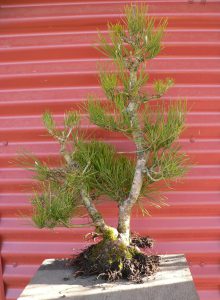
Black pine after root pruning
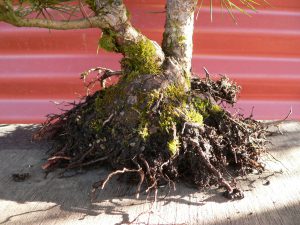
nebari
Among the roots lies a clue to the origins of this tree.
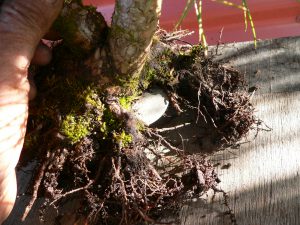
This is one of the pines mentioned in the previous post. Seedlings were threaded through a hole in stainless steel disks to see if pines could be developed in a similar way to the maples as outlined in previous posts. Pines do not root quite as well as maples and only 2 out of 5 survived the process but the experiment did prove that it can be done.
In this case I put 2 seedlings through the same hole. In the process of growing new roots they have fused into a single twin trunk tree.
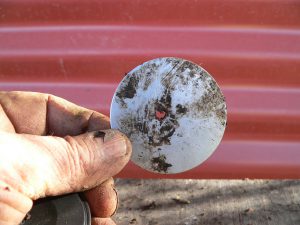
the steel disc
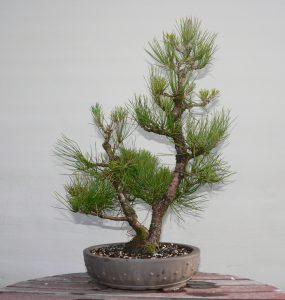
I’ve selected a round drum pot which has adequate size for a developing tree but still a reasonable match to the tree.
Now we wait until December for the first round of candle pruning to start the process of developing branches with full ramification.
Here’s one way of starting a good lateral root system. It works particularly well with trident maples but I have also used it on Japanese maples successfully and it should work well with any species that layers easily. Continue reading
It is winter at Shibui Bonsai and time to dig the trees in the grow beds.
I’m now digging most deciduous trees every year. This will slightly reduce trunk thickening but that should be more than made up for in better nebari and better nebari seems to produce vastly improved basal flare, particularly on trident maples. Continue reading
The autumn colours are gone and winter is usually pretty drab in the bonsai garden unless you have flowering Japanese Quince. Also known as Chaenomeles, most of the garden varieties flower later in winter, before the leaves sprout but this variety, called ‘Chojubai’ has occasional flowers all year round and a more concentrated display right through winter.
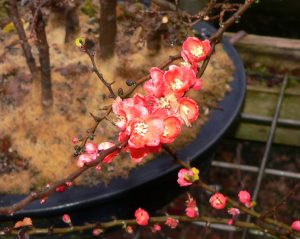
Chojubai flowers
The brilliant orange flowers are small which is an advantage for bonsai.